 Software Development
 Security Services
 Cloud Services
 AI Services
 Other Services






 TechMagic Academy


From Idea to Launch: The Complete Guide to Healthcare Software Product Development in 2026
Last updated:11 June 2026



The global digital health market is projected to reach $177.77 billion in 2026, with the United States the single largest market at $54.96 billion, according to Statista. That money is chasing a hard problem. Healthcare software product development is slower, more regulated, and more expensive to get wrong than almost any other kind of software.
Here is the trap. You can build a SaaS feature in a weekend and fix it in the next sprint. In healthcare, the same shortcut can mean a failed audit, a stalled enterprise deal, or a rebuild months before launch. The teams that win treat compliance and architecture as day-one decisions and build them in from the start.
In our new article, we cover what makes healthcare software different, the full development process stage by stage, US compliance requirements, realistic 2026 costs, the biggest challenges, and how to choose the right build partner.
Key takeaways
- Healthcare software product development is the end-to-end process of designing, building, and launching medical software under strict privacy, safety, and interoperability rules. Compliance shapes cost and speed at every stage.
- Compliance-first architecture is cheaper than retrofitting. Adding HIPAA controls after the fact can cost three to five times more than building them in from the start.
- US healthcare software must usually meet HIPAA, HITECH, and HL7 or FHIR interoperability rules. Software as a Medical Device may also need FDA clearance.
- A healthcare MVP typically costs $80,000 to $150,000, a full product $150,000 to $400,000, and enterprise platforms more. EHR integrations add $15,000 to $50,000 each.
- The right partner has real healthcare domain experience, a compliance track record, and a discovery-first process. Domain experience is the strongest predictor of a clean launch.
What Makes Healthcare Software Products Different From Other Software?
Healthcare software products are different because three constraints apply at once: patient safety, data privacy law, and the need to connect with systems you do not control. The usual B2B SaaS playbook breaks here, because every change touches regulated patient data.
Change your data architecture after launch and that single move can trigger a new HIPAA risk assessment, updated Business Associate Agreements (BAAs), and weeks of compliance review.
The forces that shape healthcare product development
This is the reality for product development for healthcare industry teams. The healthcare sector spans a broad range of products, from EHR systems, telemedicine, and remote patient monitoring to clinical decision support, software for clinical trials, and AI in medical imaging and diagnostic tools.
These software solutions and software applications run on connected healthcare devices used by healthcare providers and healthcare organizations. So, new product development in healthcare follows the usual lifecycle with extra compliance gates.
Healthcare product development is shaped by cost, too. Because developing software products for the medical industry carries a compliance cost at every decision, two key considerations shape each build: how much patient data you touch, and how many existing systems you connect to.
Rising costs of care push buyers toward software that proves its cost-effectiveness. Emerging technologies raise the bar further: Artificial Intelligence and Machine Learning now make significant contributions to clinical product development, from predictive analytics to medical imaging, and the medical device industry is moving fast to build new medical devices around them.
Compliance-first architecture: why you can't bolt it on later
Compliance-first architecture means designing data storage, access, and audit logging to meet the rules before you write feature code. You cannot bolt it on later without paying a steep tax. Retrofitting HIPAA controls into a finished product commonly costs three to five times more than building them in from day one.
The reason is structural. Encryption, access control, and audit trails touch the data layer, so changing them late means reworking the foundation rather than the surface. We have seen a startup that built a patient data feature on standard cloud storage with no HIPAA-compliant configuration. Six months before launch, they had to rebuild the entire data layer, which pushed the date and burned significant resources.
In healthcare, the data layer is a launch decision. Treat it like one from day one.
Clinical UX: designing for doctors, nurses, and patients at the same time
Clinical user experience is hard because one product serves users with opposite needs. Doctors need speed and precision, often under three seconds per screen. Patients need clarity and reassurance. Administrators need auditability and complete records. These goals pull against each other inside the same software product.
Here is a concrete clash. An EHR input form built for a physician packs dense fields and codes into one screen, which is efficient for a trained clinician. Drop that same density into a patient portal and people get confused and abandon the task. Patients now judge a portal against the consumer apps on their phone, which raises the bar for healthcare mobile app development.
The fix is role-based design: tailor each interface to its user, share one clean data model underneath, and run user testing with real clinicians and patients before you build at scale. Your users span the whole career arc, from medical students learning the system to attending physicians who live in it all day. Good clinical UX is how you actually enhance patient care rather than just digitize a form.
Interoperability reality: what EHR integration actually involves
EHR integration is the work of connecting your product to systems like Epic or Cerner so they can exchange data safely. It is not plug-and-play, and underbudgeting it is the most common planning mistake we see. A typical Epic integration takes six to 12 weeks, costs $15,000 to $50,000, and needs sandbox access, FHIR R4 mapping, and sign-off from the health system's IT team. Most founders budget two weeks and $5,000.
Fast Healthcare Interoperability Resources (FHIR) is the modern standard for moving clinical data between existing healthcare systems. In practice, FHIR gives you a shared format, but you still map your data model to it, handle authentication, and test against each system's quirks. System integrations with legacy hospital software remain some of the hardest engineering in the field.
What Are the Key Stages of the Healthcare Software Development Process?
The healthcare software development process runs through eight stages: discovery and product validation, compliance mapping, UX/UI design, architecture, development, QA and compliance testing, launch, and iteration. The order in this product development process matters, because compliance and architecture decisions in the first stages set cost and speed in every later one.
The most expensive mistakes happen when teams treat compliance as a final checkbox. Map it early and the rest of the development process gets faster and cheaper. The table below shows who owns each stage and a realistic timeline for a first product.
Discovery: validating the product idea and defining scope
Discovery validates that the product solves a real problem before you spend on engineering. It pairs thorough market research with interviews of healthcare professionals and a tightly defined minimum viable product (MVP). The goal is one core workflow done well. A broad feature list can wait.
Scope discipline matters more in healthcare because every feature carries a compliance cost. A focused MVP around a single workflow, such as remote monitoring for one condition, keeps your first audit and your first integration manageable. Good discovery also surfaces the data that will later provide valuable insights once the product is live.
Compliance mapping before writing a single line of code
Compliance mapping documents what data you handle, where it flows, and which regulatory requirements apply, all before development starts. It answers whether you touch protected health information, whether you need a BAA with each vendor, and whether your product is a medical device. This is the single highest-leverage stage in healthcare software product development.
Mapping early prevents the costly rebuilds described above. When you know your regulatory compliance obligations on day one, your architecture and your development team plan around them instead of reacting later.
Development, QA, and launch: what to expect at each step
Development, QA, and launch in healthcare add compliance gates to a familiar flow. Engineers build the features and system integrations, QA runs functional and security tests, and a separate compliance test cycle checks that controls like encryption and audit logging actually work. Each release goes through this loop, which is why QA is ongoing rather than a one-time phase.
Plan the development process as a repeatable cycle:
Discover → Map compliance → Design → Build → Test → Launch → Iterate
That rhythm keeps data security and regulatory checks inside every sprint, so nothing waits for a final scramble before launch.
We're here to help

What Compliance Requirements Must Healthcare Software Meet in the US?
US healthcare software must meet HIPAA and HITECH for privacy and security, HL7 or FHIR for interoperability, and, for some products, FDA 21 CFR Part 11 and medical device rules. ISO 27001 and HITRUST are common on top, especially for enterprise buyers. Strong regulatory compliance is a product feature: it builds trust, unlocks enterprise sales, and protects you from penalties.
Frame compliance as a path to revenue rather than a tax. The table below maps the main frameworks decision-makers need to understand.
HIPAA and HITECH: what founders must build in from day one
HIPAA and HITECH require that any product touching US patient data protect it with encryption, strict access control, audit logging, and signed BAAs with every vendor that sees that data. HITECH adds breach notification duties and tougher enforcement. These are build-time requirements. You cannot add them as paperwork at the end.
From our experience, the teams that handle this well decide their HIPAA scope during compliance mapping, then encode it in architecture. That keeps medical data and clinical data protected by design, which is exactly what auditors and hospital buyers check first.
HL7 and FHIR: interoperability requirements and EHR integration
HL7 and FHIR are the standards that let healthcare systems exchange data with each other and with your product. HL7 v2 is the older messaging standard still common in hospitals; FHIR is the modern API-based approach most new integrations use. If your product reads or writes records in an EHR, you will implement FHIR R4 and test against each system you connect to.
Interoperability is where many digital health solutions stall. Budget real time for it, because connecting to existing systems is real engineering work rather than simple configuration.
FDA SaMD classification: does your product qualify as a medical device?
Software as a Medical Device (SaMD) is software that performs a medical function on its own, such as software that diagnoses a condition or recommends treatment. If your product makes clinical claims, it may need FDA regulatory approval and a quality management system, which adds time and cost. Pure administrative or wellness tools usually fall outside that line.
This classification shapes your roadmap, so check it early. Many medical device companies and the wider medical device industry build their entire development process around FDA gates, and a misjudged classification can reset your timeline. When in doubt, get a regulatory opinion before you build.
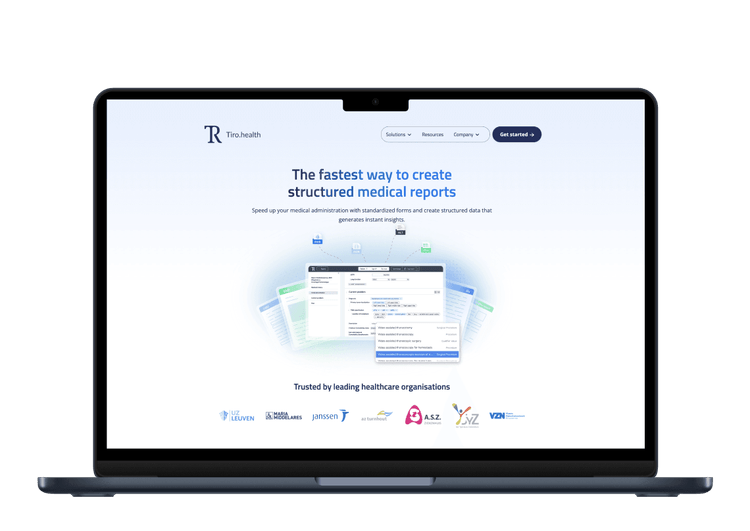
digital platform for medical form management
How Much Does Healthcare Software Product Development Cost in 2026?
Healthcare software product development in 2026 typically costs $80,000 to $150,000 for an MVP, $150,000 to $400,000 for a full product, and $400,000 or more for an enterprise platform. The range depends on workflows, integrations, and how much compliance work your product needs. Costs run higher than general software because of security, testing, and integration overhead.
The figures below give decision-makers a planning baseline. A firm quote still depends on your scope.
Cost breakdown by development stage
Cost tracks the development stages. Discovery and design are a small share, development is the largest, and compliance testing and integrations add real weight near the end. These are average numbers, so pay attention: the real budget for your project might differ.
Hidden costs: compliance, EHR integrations, QA cycles
The costs founders miss are the ones outside the feature list. A HIPAA compliance audit, each EHR integration at $15,000 to $50,000, repeated QA and compliance test cycles, and ongoing maintenance and security updates all add up. These costs recur every year, and they are where thin budgets break.
Plan for maintenance from the start. Security patches, dependency updates, and re-testing after each change are the cost of keeping medical software safe in production.
How to calculate ROI and build your business case
Return on investment (ROI) in healthcare unfolds over years and includes patient outcomes alongside dollars. A telehealth platform that cuts avoidable hospital visits by 15 percent lowers cost and widens access at the same time. Build your business case on three numbers: cost saved, revenue enabled, and patient outcomes improved.
A simple framework helps decision-makers compare options:
- Cost saved: staff time, avoided visits, fewer errors, and the cost effectiveness of automating administrative data entry and financial tasks like billing.
- Revenue enabled: new contracts, faster enterprise sales from a compliant posture, and a real competitive advantage.
- Outcomes improved: patient engagement, adherence, and clinical results that strengthen renewals.
Funding supports the case. North American digital health ventures raised $7.5 billion in the first half of 2025, per Statista, so capital is available for products that show a clear ROI path.
Check our

What Are the Biggest Challenges in Healthcare Software Product Development?
The biggest challenges are regulatory complexity, EHR integration friction, recruiting domain-expert developers, aligning clinical and compliance stakeholders, and long enterprise sales cycles. Each is solvable with the right process. These are the unique challenges that separate healthcare from other software product work.
This is where a healthcare software development company earns its fee, so the fixes below come from real delivery work rather than generic advice.
Navigating HIPAA, FDA, and compliance requirements without slowing down
The challenge is meeting regulatory requirements without freezing your roadmap. The fix is to front-load compliance mapping and reuse a documented control set across releases, so each new feature inherits proven patterns instead of starting from zero. A compliance checklist tied to your architecture turns a recurring blocker into a routine step.
We also keep a compliance lead in planning, and not only in review. Catching a regulatory issue during design costs hours; catching it after launch costs a rebuild.
EHR integration: connecting with Epic, Cerner, and legacy systems
The challenge is that Epic, Cerner, and older systems each behave differently, so one integration rarely transfers cleanly to the next. The fix is an integration layer that isolates each connection behind a common FHIR-based interface, plus early sandbox access so your team tests against real behavior. This contains the friction instead of letting it spread through your codebase.
Treat each integration as its own mini-project with its own timeline. That keeps surprises from one health system out of your core release schedule.
Recruiting and managing a team that understands both code and clinical workflows
The challenge is that strong engineers rarely arrive with a deep understanding of clinical workflows, and clinicians rarely write production code. The fix is a blended development team: senior engineers paired with people who know healthcare delivery, supported by clinical advisors. This is the gap between healthcare technology and product development, and bridging it is mostly a hiring and pairing problem.
Many teams solve capacity and expertise at once through healthcare software development outsourcing with a partner that already has domain experience. It is often faster than building a specialized team from scratch.
How Do You Choose the Right Healthcare Software Development Partner?
Choose a partner by checking healthcare domain experience first, then compliance track record, a discovery-first process, transparent estimates, and relevant references. Domain experience is the strongest predictor of a smooth launch, because a generalist team learns healthcare's rules on your budget and your timeline.
This decision deserves real diligence. About 70 percent of US health care executives plan to pursue alliances with technology or digital companies in 2026, according to Deloitte, so picking the right one is a board-level concern rather than a procurement detail.
Key criteria: domain expertise, compliance track record, process
The criteria that matter are concrete. Ask for HIPAA and FHIR project examples, named references in your space, and a clear discovery-first process. A credible healthcare software development company will show you compliance artifacts and case studies, well beyond a portfolio of unrelated apps.
Ask these questions during evaluation:
- Which HIPAA and FHIR projects have you shipped, and can we speak to those clients?
- How do you handle compliance mapping and BAAs before development starts?
- Who owns security testing, and what does your QA cycle look like?
- How do you scope an MVP and estimate cost and timeline?
Red flags to watch for when evaluating vendors
The red flags are easy to spot once you know them. Be cautious of a vendor who promises a fixed price before discovery, has no healthcare references, treats compliance as an add-on, or cannot explain FHIR in plain terms. A team that underbudgets integration is telling you it has not done many.
Honestly, the loudest warning sign is a partner who never says no. Good healthcare teams push back on scope that adds compliance risk for little user value.
In-house vs. outsourcing vs. nearshore: a decision framework
The right model depends on your timeline, budget, and how much healthcare expertise you already have. The table compares the three common options on the factors that decide most builds.
Our Experience in Healthcare Software Product Development
We build custom healthcare software product development projects across HealthTech, from EHR and EMR portals to telemedicine and remote patient monitoring. Our work pairs senior engineers with healthcare domain knowledge, and we map compliance before code so the architecture carries HIPAA and FHIR requirements from the start.
In practice, we built a HIPAA-compliant EMR portal for MHC Healthcare, where access control and audit logging were the core of the design. On Tiro.health, we owned frontend and UX for a medical form platform built to WCAG 2.2 accessibility and FHIR, so clinical data could move cleanly between existing systems. Both projects show the same pattern: get the data layer and compliance right early, and the rest of the development process speeds up.
The hardest part is rarely the feature work. It is aligning all the stakeholders, clinical, IT, and compliance, on one scope while an integration timeline and a launch date both press in. That is also where founders building their first healthcare product gain the most from a team that has shipped before. For teams weighing a build, our guide to healthcare app development covers the product side in more depth.
What clients value most is the proof that compliance and clinical fit were handled from day one, even more than the code itself.
We're here to share our expertise

Final Thoughts: What's Next for Healthcare Software
If you take five decisions into your build, make them these: define your compliance scope early, scope the MVP around one core user workflow, choose a partner with healthcare domain experience, budget realistically for integrations, and plan for a long enterprise sales cycle.
Get these right, and the rest of healthcare software product development becomes manageable. A clear product development strategy in healthcare always starts with compliance and scope before anyone debates features.
Where is this heading?
Software budgets keep climbing, and healthcare is a prime target. Gartner expects worldwide software spending to grow 14.7 percent in 2026 to more than $1.4 trillion, and healthcare is one of the fastest-growing slices.
AI moves from pilot to production in clinical settings. Deloitte reports that 85 percent of health care leaders plan to increase agentic AI investment over the next two to three years, pushing machine learning, predictive analytics, and new technologies deeper into care.
Interoperability becomes table stakes. As FHIR adoption widens at global scale, buyers will expect new products to exchange data with existing healthcare systems on day one and treat a later add-on as a deal-breaker.
None of this has to feel overwhelming. Start with a tight scope, get compliance and architecture right early, and let each release build on the last.

FAQ

Healthcare software product development is the end-to-end process of designing, building, testing, and launching software for the medical industry under privacy, safety, and interoperability rules. It covers products such as EHR systems, telemedicine, and remote patient monitoring, and it treats HIPAA compliance and architecture as day-one decisions.
Healthcare software product development usually takes three to six months for a focused MVP and longer for a full product. The timeline depends on the number of workflows, EHR integrations, and compliance gates, since each integration can add six to 12 weeks on its own.
Healthcare software in the United States must meet HIPAA and HITECH for privacy and security, and HL7 or FHIR for interoperability with healthcare systems. Software that performs a medical function may also need FDA clearance under Software as a Medical Device rules, and enterprise buyers often expect ISO 27001 or HITRUST.
Choosing a healthcare software development partner starts with healthcare domain experience, a HIPAA and FHIR compliance track record, and a discovery-first process with transparent estimates. Ask for named references in your space, and treat any vendor who promises a fixed price before discovery as a red flag.
TechMagic builds healthcare software products for startups and scale-ups, from MVP through enterprise platforms. TechMagic runs discovery first, maps compliance before development, and builds to HIPAA and FHIR, with HealthTech case studies including a HIPAA-compliant EMR portal and a FHIR-based medical form platform.
TechMagic has direct experience with HIPAA and FHIR compliance across HealthTech projects. We map HIPAA scope during planning, encodes encryption, access control, and audit logging into the architecture, and implements FHIR R4 for EHR integration and clinical data exchange.
TechMagic can build a dedicated or hybrid team for a healthcare product, pairing senior engineers with healthcare domain knowledge and clinical advisors. This model gives healthcare companies both engineering capacity and the deep understanding of clinical workflows that healthcare software product development requires.