
 Software Development
 Security Services
 Cloud Services
 AI Services
 Other Services






 TechMagic Academy


GitHub Copilot vs ChatGPT: Everything You Need To Know About
Last updated:1 March 2025


Let's be honest: most people prefer others to do the work for them. We all want to delegate and focus on the important things. At least in software development, AI has given us a game-changing solution: AI code-writing assistants.
Did you know that nearly 90% of people prefer doing their work by others? We all strive to delegate tasks and focus on more important aspects of our work. Luckily, in software development, artificial intelligence has introduced a game-changing solution: AI code-writing assistants.
GitHub Copilot and ChatGPT are the two leading AI code writing tools. While both can improve writing speed and give you code snippets, they have different strengths and are for different purposes. In this article, we’ll go deep into the difference between ChatGPT and GitHub Copilot, their features, and capabilities. We'll also discuss use cases, so you can make an informed decision when choosing between GitHub Copilot and ChatGPT.
Key takeaways
- GitHub Copilot and ChatGPT both help developers work faster, but they serve different needs. In Copilot vs ChatGPT, Copilot is more coding-focused, while ChatGPT is broader.
- Copilot works best inside the IDE for code suggestions, refactoring, and faster implementation.
- ChatGPT is stronger for explanations, debugging help, planning, and learning.
- Neither tool is fully reliable on its own, so human review and testing still matter.
- The main difference between GitHub Copilot and ChatGPT is simple: Copilot supports coding in context, while ChatGPT supports wider problem-solving.
What is GitHub Copilot?
GitHub Copilot is one of the most reliable and advanced AI code completion tools. Using OpenAI’s GPT-4 natural language prediction model, Copilot analyzes code context and suggests lines for you.

How GitHub Copilot works
GitHub Copilot looks at the context of what you are doing. That includes the file you have open, the code around your cursor, your comments, and your prompt. Based on that context, it suggests code or answers that fit the task. Copilot also aligns its code suggestions with the project's existing style conventions, helping maintain consistency in your codebase.
ChatGPT offers a conversational AI experience, allowing developers to ask questions, get explanations, and generate code snippets through natural language text. Both tools aim to boost developer productivity by automating repetitive tasks and providing intelligent assistance directly within your workflow.
It can autocomplete lines of code, help answer coding questions in chat, suggest edits, and support the next steps in your workflow.
Copilot does not build a personal long-term model of your coding style. Instead, it uses the context from your current session to generate relevant suggestions. Copilot is trained on publicly available code from open repositories, which helps it provide relevant and accurate suggestions.
GitHub Copilot supports many programming languages, including:
- C
- C++
- C#
- Go
- Java
- JavaScript
- Kotlin
- PHP
- Python
- Ruby
- Rust
- Scala
- Swift
- TypeScript
Support is not the same across every language and feature. Some Copilot capabilities work better in certain languages than in others.
While Copilot is a powerful tool, it may sometimes suggest insecure coding patterns, so developers should review its suggestions for security best practices.

What is ChatGPT?
ChatGPT is a generative AI tool developed by OpenAI that can generate human-like text responses to prompts. As an AI assistant, it helps with everyday tasks such as writing, brainstorming, studying, coding, summarizing, and analyzing files or images.
ChatGPT is powered by advanced AI models, which enable it to understand and generate text based on user prompts. It is accessed as a standalone tool, available on the web and mobile apps, and is particularly well-suited for summarizing complex code or generating templates for coding tasks. ChatGPT has a free tier, and there are also paid plans with additional features.
It runs on OpenAI models, but the exact AI model can vary depending on the feature, plan, and current product updates.

How ChatGPT works
You type a prompt or question, and ChatGPT generates a response based on the context of your request. ChatGPT uses a chat interface, allowing users to interact conversationally and answer questions about code, troubleshooting, or technical topics.
It is designed to follow instructions in a conversational way, so it can answer follow-up questions, refine earlier responses, explain mistakes, and help with a wide range of tasks. ChatGPT operates mainly in standalone interfaces and relies on user-provided information for context.
ChatGPT generates responses by learning patterns from large amounts of information and predicting the most likely next pieces of content. Even so, it can still make mistakes or give incomplete answers, so important information should be checked.
Let’s Start With Similarities
GitHub Copilot and ChatGPT both use large language model technology to understand prompts and generate useful responses. In both tools, you can describe what you need in plain language and get output that is easy to read and act on. That output may include code, explanations, or suggested next steps.
Both tools can help developers work faster. They are good at handling repetitive tasks, drafting code or text, and giving quick support when you need a starting point. They also rely heavily on context, which means the quality of the response depends on what you ask and how much relevant information you provide.
And Move to Differences in Essence
The main difference is focus. GitHub Copilot is built primarily for generating software code and works directly inside development tools such as IDEs, the GitHub website, the GitHub CLI, and Windows Terminal. It is designed to support hands-on development with in-context code suggestions, chat, and coding workflows.
ChatGPT is broader. It can help with software code, but it is also designed for many other tasks, such as writing, brainstorming, learning, planning, summarizing, and analyzing files or images. It works more like a general-purpose AI assistant than a coding-first tool.
Many developers use both GitHub Copilot and ChatGPT together, leveraging Copilot for rapid software code generation and ChatGPT for deeper reasoning and explanations.
GitHub Copilot vs ChatGPT: Features
Key Features of GitHub Copilot
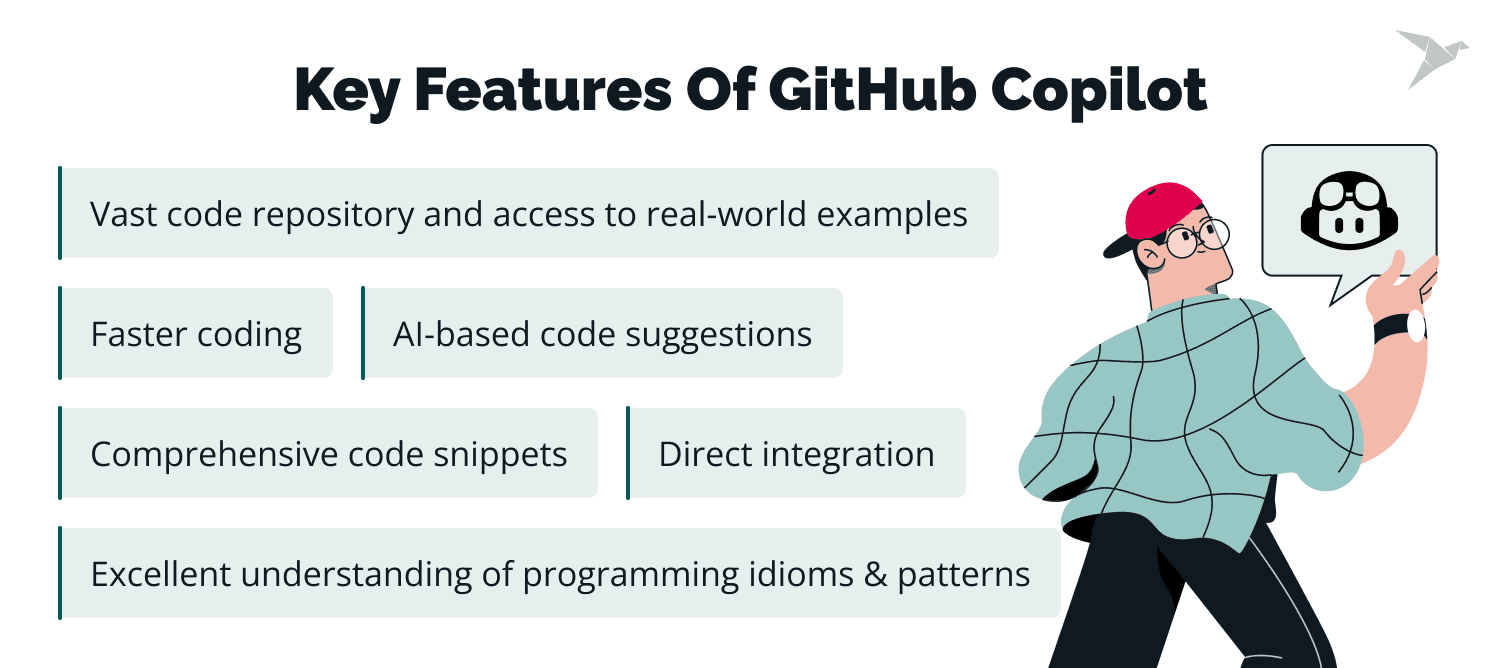
Both GitHub Copilot and ChatGPT help developers write code and solve problems faster. However, they are designed for different workflows. Copilot focuses on real-time coding inside development environments, while ChatGPT is a broader AI assistant that can help with coding, explanations, research, and writing.
The table below highlights the main differences.
GitHub Copilot vs ChatGPT: Use Cases
GitHub Copilot use cases
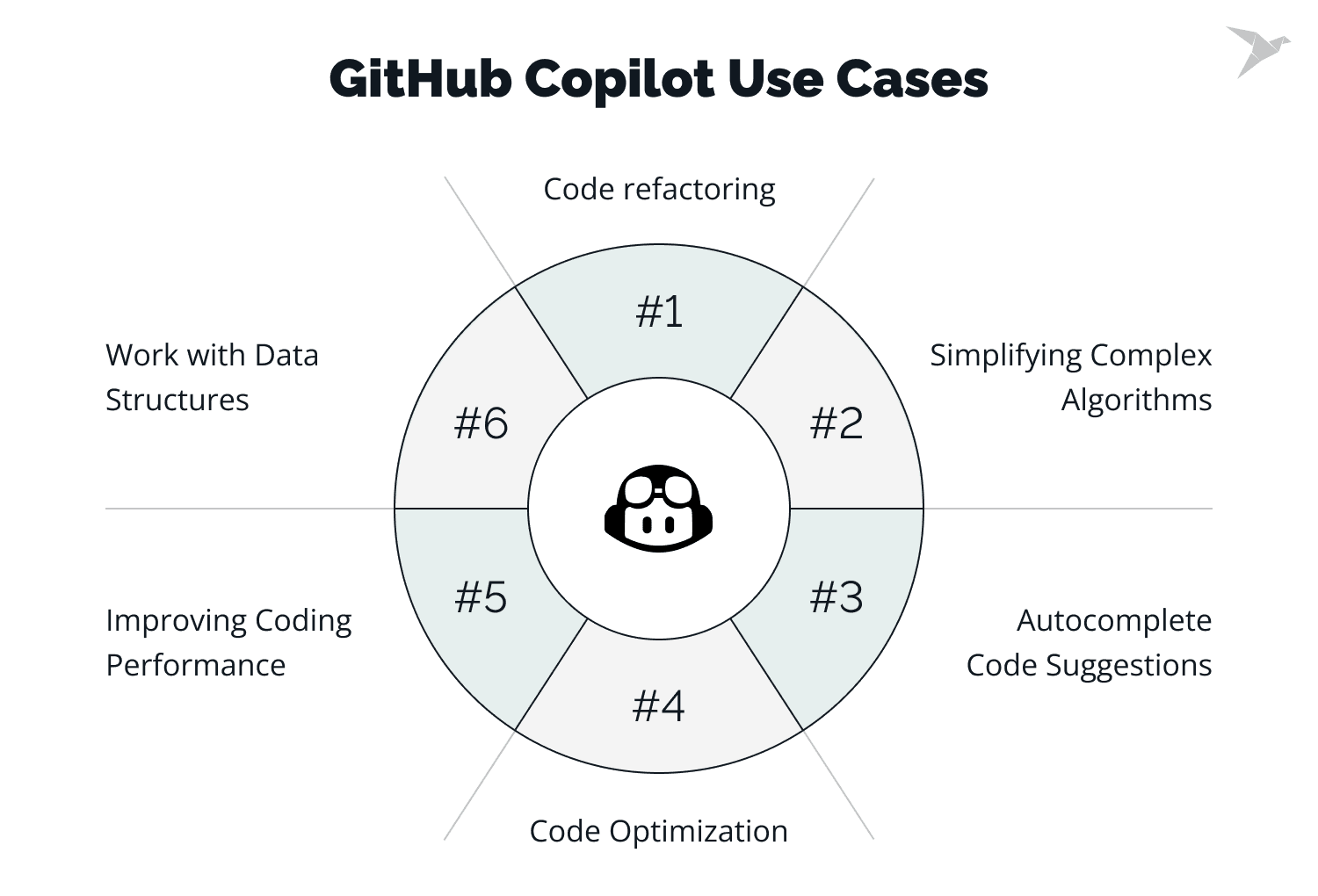
GitHub Copilot is built for coding inside the development workflow. Developed and hosted in collaboration with Microsoft, Copilot benefits from Microsoft’s expertise in AI integration and support across their products. It works best when a developer is already in the IDE or GitHub and wants help writing, editing, or reviewing code faster.
Today, Copilot does more than autocomplete. It offers inline suggestions, chat-based coding help, and coding agent features that can make code changes and support pull request workflows. For organizations, Copilot Enterprise and Business plans include IP indemnity, providing legal protection for code suggestions generated by the tool.
Common GitHub Copilot use cases include:
- autocomplete and boilerplate generation;
- function and test scaffolding;
- refactoring code in an existing repository;
- explaining code in context;
- suggesting fixes during code review or pull request work (note: Copilot can sometimes generate insecure code, so using security filters and following best practices is important).
In practice, Copilot is strongest when the task is closely tied to the codebase and the developer wants fast in-editor assistance. GitHub Copilot pricing starts at $10 per month for individuals and $19 per month for organizations.
Learn how we built macro-investing app with its own token and reward system

ChatGPT use cases
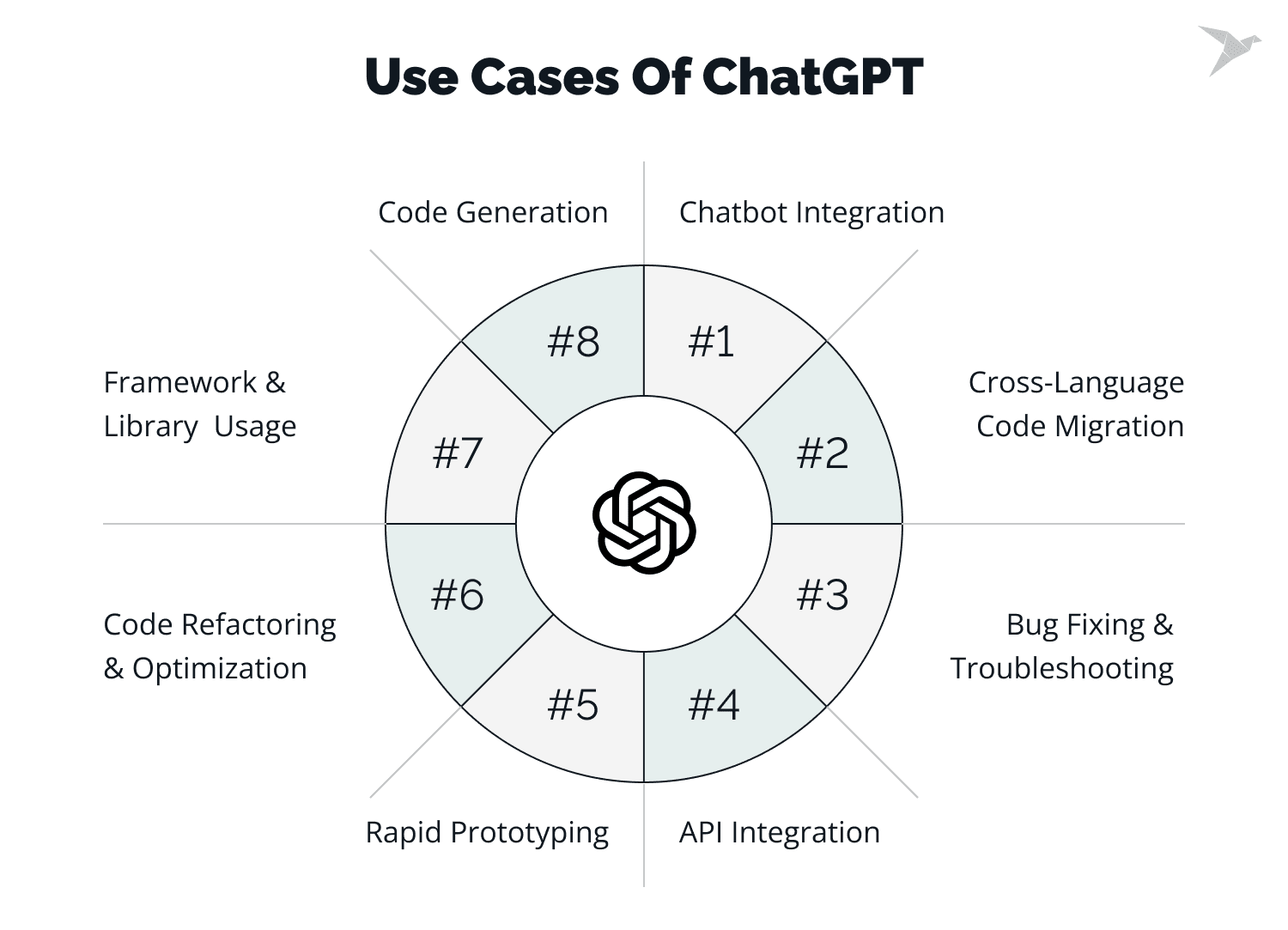
ChatGPT is broader in scope. It can help with coding, but it is also useful for reasoning, planning, explaining trade-offs, and working through technical problems step by step. OpenAI describes GPT-5.4 as a model built for professional work, with strong coding, tool use, and long-context capabilities.
Common ChatGPT use cases include:
- generating code snippets or small components;
- explaining bugs and troubleshooting issues;
- planning architecture or implementation approaches;
- helping with API integration;
- supporting rapid prototyping from natural-language requirements;
- learning new frameworks or libraries;
- translating logic between programming languages;
- drafting documentation, tests, and technical notes.
ChatGPT is especially helpful when the task goes beyond a single file and requires reasoning, explanation, or cross-functional thinking.

ChatGPT vs GitHub Copilot: Limitations
GitHub Copilot Limitations
GitHub Copilot is useful, but it still needs careful review. GitHub notes that its suggestions can be incomplete, incorrect, or insecure, so developers should test and validate the output before using it in production.
It follows patterns, not product logic
Copilot works by predicting likely code from patterns and context. That makes it fast, but it does not understand business rules, architecture, or long-term product goals. A suggestion may look right and still be the wrong fit for the system.
Output quality is not consistent in every case
Copilot tends to work best on common coding tasks and familiar patterns. Results can be weaker when the task is complex, the context is limited, or the language and framework are less common. GitHub supports many languages and environments, but the quality of suggestions is not equal across all of them.
Access and features can vary
Some Copilot capabilities depend on the plan, environment, and feature availability. GitHub also applies usage limits, which can affect access in practice.
Overall, Copilot is best used as a coding assistant, not as a source of final decisions.
Limitations of ChatGPT
It can sound confident and still be wrong
ChatGPT is useful, but it can still make mistakes. OpenAI advises users to treat it as a first draft, not a final source, and to verify important facts, technical details, and references before using them.
It does not fully understand your system
ChatGPT can explain code, suggest fixes, and help with planning. But it does not know your product, architecture, or business rules unless you provide that context. Even then, it may miss constraints that matter in production. This is why human review is still necessary for important decisions.
Output quality depends on the prompt and context
Results can vary based on how clearly the task is described and how much relevant context the model has. Vague prompts or missing details often lead to weaker answers, generic code, or incorrect assumptions.
It should not replace expert validation
ChatGPT can speed up research, writing, and coding support, but reliability still depends on human oversight. OpenAI’s guidance is clear: check important information, use trusted sources, and validate output before relying on it in high-stakes work.
Overall, ChatGPT is best used as a support tool, not as the final decision-maker.
Applicability
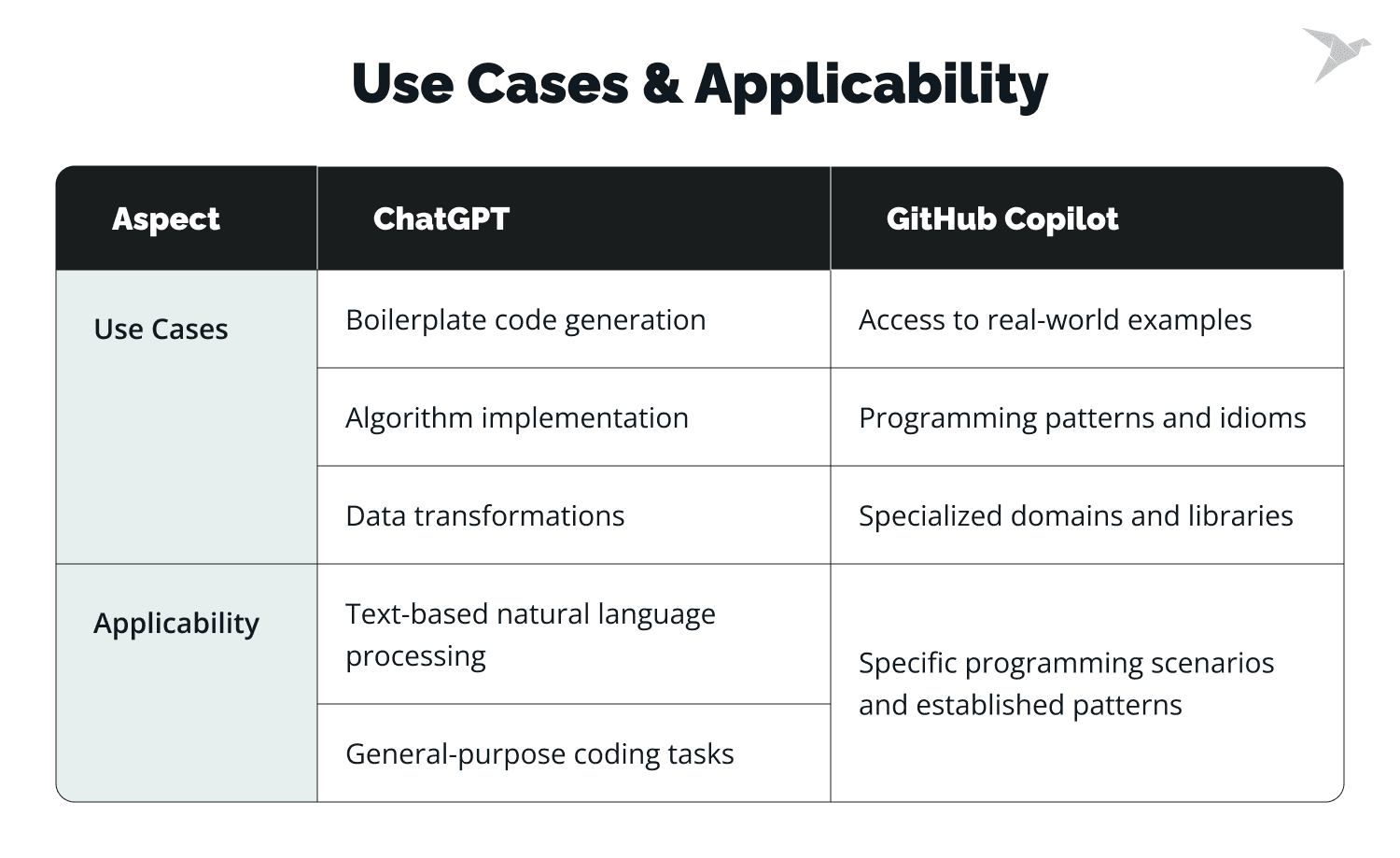
When considering the use cases and applicability of ChatGPT and GitHub Copilot, it becomes evident that each tool has its strengths and is better suited for specific scenarios. Let's explore these scenarios in detail.
ChatGPT
ChatGPT demonstrates its value in various situations where developers require assistance with general-purpose coding tasks. Some key use cases include:
- Boilerplate code generation
- Algorithm implementation
- Data transformations
GitHub Copilot
GitHub Copilot excels in specific situations where its strengths, such as a vast code repository and an understanding of established programming patterns, are highly valuable. Here are some notable use cases:
- Access to real-world examples
- Programming patterns and idioms
- Specialized domains and libraries
The choice between ChatGPT and Copilot often hinges on the specific requirements of the development project. Consider the following examples:
- Startup rapid prototyping: ChatGPT's versatility and ability to generate code with explanations may be more beneficial for a startup focused on rapid prototyping and experimentation. It provides a broader range of support across various coding tasks, allowing developers to iterate and explore different ideas quickly.
- GitHub repository integration: When a development team relies extensively on GitHub repositories for code collaboration and version control, GitHub Copilot's seamless integration with GitHub becomes a significant advantage, as well as GitHub Mobile Copilot options.
- Project-specific requirements: The choice between ChatGPT and Copilot can depend on the specific requirements of a project. For example, ChatGPT's capabilities in generating human-like text may be more valuable if a project involves primarily text-based natural language processing. Alternatively, if a project heavily relies on existing code patterns and libraries, Copilot's expertise in leveraging established programming patterns becomes a determining factor.
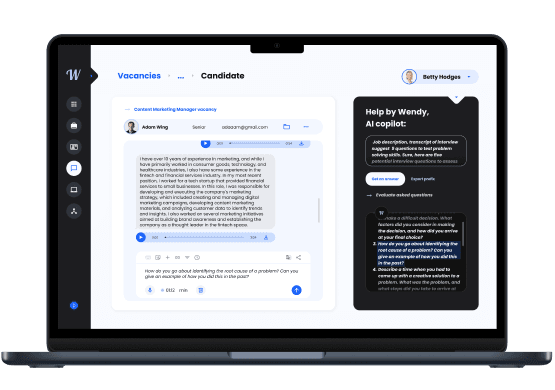
Learn how we built an AI-powered recruitment assistant using OpenAI stack
Performance Evaluation
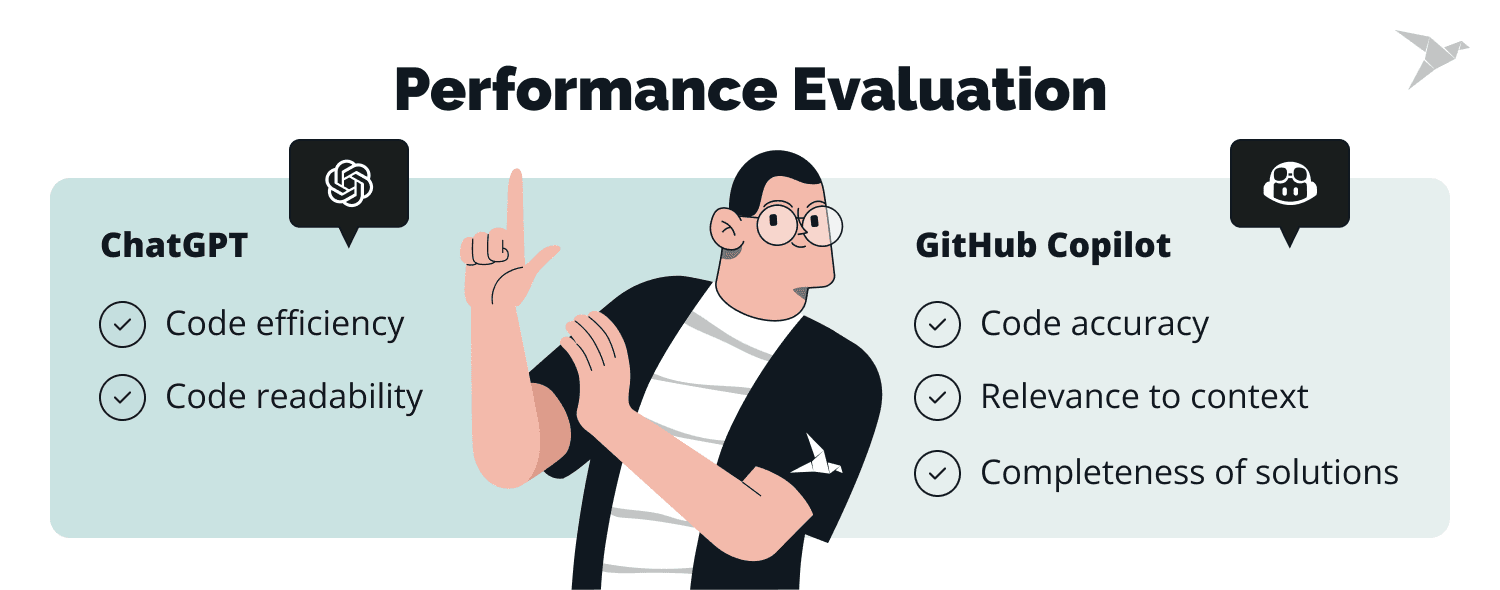
By conducting a thorough evaluation, we can gain insights into the effectiveness and reliability of the code offered by ChatGPT. Some evaluation methods may involve:
- Code efficiency: Assessing the performance and computational complexity of the generated code to ensure it meets the desired efficiency standards.
- Code readability: Evaluating the clarity and comprehensibility of the generated code, considering factors such as variable naming, code structure, and overall organization.
Examining the code offered by Copilot is crucial to understanding its performance in terms of generating code and comprehension. Evaluation methods may include:
- Code Accuracy: Verifying the correctness and reliability of the code offered by Copilot through testing, debugging, and code review processes.
- Relevance to Context: Assessing how well Copilot understands the context and requirements developers provide, ensuring that the generated code aligns with the intended functionality.
- Completeness of Solutions: Evaluating whether Copilot offers comprehensive and robust code snippets that cover all necessary aspects of the given coding task.
Both ChatGPT and Copilot may encounter performance limitations or face challenges in certain scenarios.
- ChatGPT may struggle with understanding abstract or ambiguous prompts and may find it difficult to generate code that meets strict security requirements or handles sensitive data appropriately.
- Copilot's performance may be limited when dealing with rare or specialized programming scenarios, where the availability of relevant real-world examples or established patterns is limited.
Code Comparison
GitHub Copilot and ChatGPT serve different purposes regarding generating code and assistance. Let's compare their capabilities using the same query in Python.
Copilot
The primary task of GitHub Copilot is to complete code and assist developers in boosting their productivity, especially with repetitive and simple code snippets. Copilot suggests concrete function implementations based on the existing codebase and project context. For example, if you need to implement a parseExpression() function, Copilot will analyze the structure, public code above, legacy code, and overall context of your project to provide suggestions on how to complete this specific functionality efficiently.
ChatGPT
On the other hand, ChatGPT is a chatbot framework that extends its assistance beyond code completion. While it can still help developers in the development process, ChatGPT's strength lies in its ability to help design large-scale systems and provide a roadmap for implementation.
It can also assist users in tasks such as creating the syntax for a new programming language, building context-free grammar, and recommending steps for compiler implementation. ChatGPT takes a broader perspective and offers guidance on the architecture and implementation of complex systems.
When comparing the two tools using the same Python query, Copilot will focus on generating code snippets for specific functionalities. At the same time, ChatGPT will provide a more comprehensive approach, offering insights into developer experience and recommendations on designing and implementing the entire system.
Accuracy of Response
Both ChatGPT and GitHub Copilot can be helpful, but neither is fully reliable on its own.
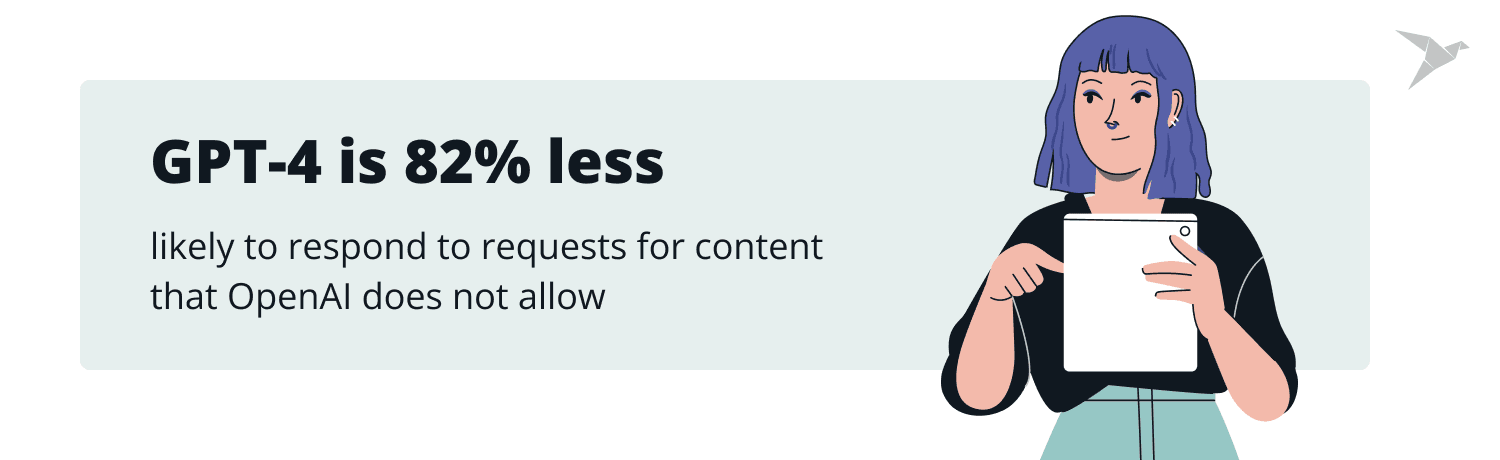
ChatGPT can produce strong explanations and useful code, but it can still make factual or technical mistakes. OpenAI reported that GPT-4 was 82% less likely to respond to disallowed requests and 40% more likely to produce factual responses than GPT-3.5 on internal evaluations. Even so, code and technical output still need human review.
GitHub Copilot has similar limits. GitHub reported that users accept nearly 30% of Copilot suggestions on average, which shows that many suggestions are useful, but many are also rejected. Suggestion quality depends on the language, task, and context.
In practice, both tools are best used as assistants. They can speed up work, but accuracy still depends on testing, validation, and developer judgment.
GitHub Copilot also faces accuracy issues, and users accept an average of 26% of all code completions shown by the tool. In specific languages like Python, this acceptance rate increases to 40%. It is important to understand that GitHub Copilot does not generate perfect code. Instead, it strives to create the best possible code based on the available context. Overall, GitHub Copilot's code tends to be more reliable compared to ChatGPT's capabilities in coding tasks.
Integration
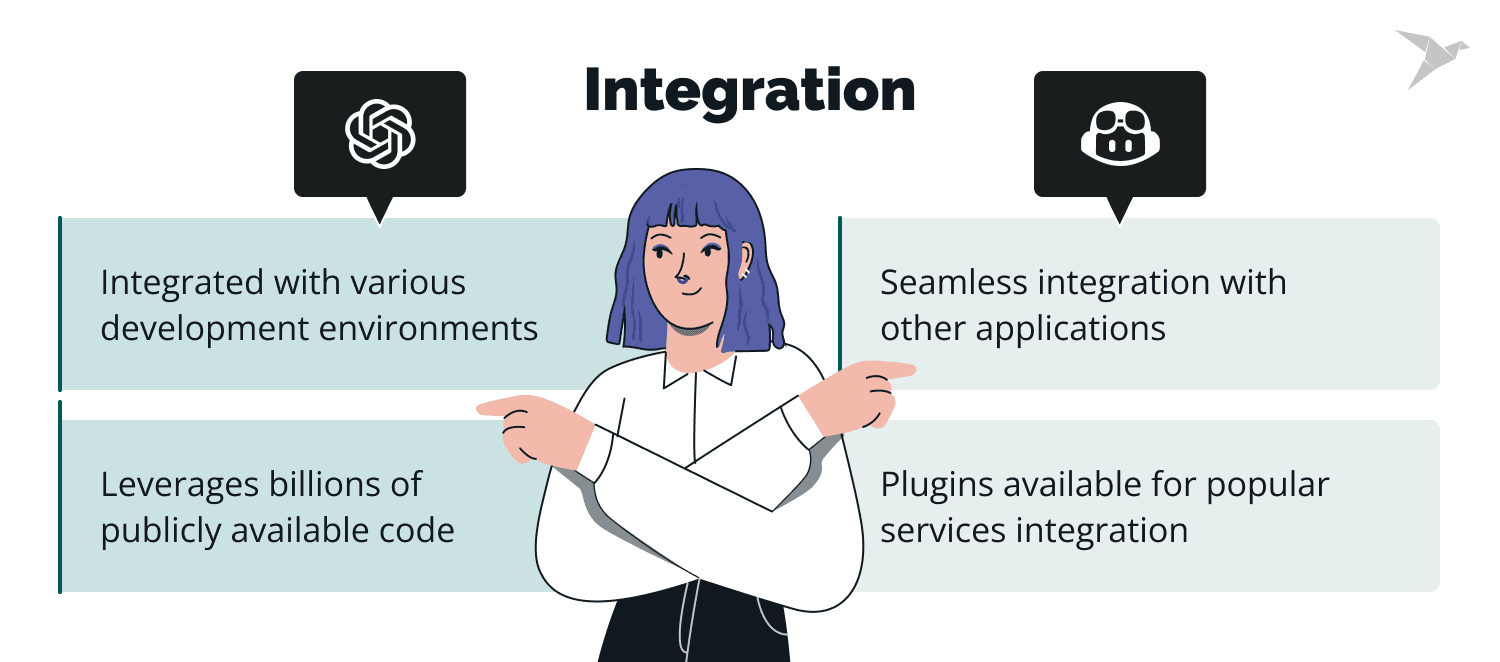
ChatGPT
ChatGPT can be seamlessly integrated into other applications using its API. This enables developers to generate responses and converse with users within their software or platforms. Additionally, plugins are being developed to enhance the integration of ChatGPT with popular services like Kayak, Expedia, OpenTable, Slack, and Shopify, among others. ChatGPT also boasts integration with a wide range of programming languages.
GitHub Copilot
GitHub Copilot is tightly integrated with several development environments, including VS Code, Visual Studio, Neovim, and JetBrains IDEs. This enables developers to use Copilot's code generation and completion features seamlessly within these IDEs. GitHub Copilot users can analyze and make software code and draw from billions of publicly available code across multiple programming languages.
Security
ChatGPT
ChatGPT has not received extensive attention regarding security measures. Developers utilizing ChatGPT are responsible for incorporating their security features and considerations into the applications or systems they build. While OpenAI, the organization behind ChatGPT, emphasizes the importance of security, it does not provide access to specific built-in security features for the tool itself.
GitHub Copilot
GitHub Copilot benefits from the robust security features implemented on the GitHub platform over the years. As a part of GitHub's ecosystem, Copilot leverages the security measures provided by GitHub to ensure a secure coding environment for users. For business users, Copilot offers them access to additional coding privacy and protection measures.
One notable security feature of GitHub Copilot is its AI-based vulnerability prevention system. This system actively identifies and blocks insecure code and insecure coding patterns in real time. It targets common vulnerable coding patterns, such as hardcoded credentials, SQL injections, and path injections.
Final Thoughts
When comparing GitHub Copilot and ChatGPT, it's important to consider specific use cases. To make a decision, consider programming language preferences, project complexity, and team dynamics. Evaluate your projects' specific requirements and your team members' expertise. Experimenting with both tools and assessing their performance for your needs may be beneficial.
While these AI tools offer significant benefits, they are not flawless. ChatGPT and GitHub Copilot have limitations and may occasionally provide inaccurate or incomplete results. Therefore, reviewing and validating the output generated by these tools is essential, especially regarding critical tasks or sensitive source code itself.
Embracing the symbiotic relationship between human intelligence and AI technology will enhance user productivity, innovation, content creation, and success in software development.

FAQ

GitHub Copilot smoothly integrates editors like Visual Studio Code into code and is mainly used while developing. ChatGPT is a wider-oriented language model that can deal with a variety of text-based tasks. These tasks include answering queries, writing emails, and creating content.
Though GitHub Copilot can produce large sections of code and provide valuable recommendations, it shouldn't replace human programmers. It's best utilized as a tool to boost efficiency and cut down on monotonous coding tasks.
GitHub Copilot is better suited for debugging and code assistance because of its direct integration with development environments and ability to offer context-aware code suggestions. ChatGPT can provide explanations and steer developers toward coding concepts, but it still lacks a direct link with development tools.
Financial considerations may apply to both GitHub Copilot and ChatGPT. GitHub Copilot utilizes a subscription model for individual and enterprise users, whereas ChatGPT charges might be determined by specific API usage or subscription tiers offered by OpenAI.
You need to install the GitHub Copilot extension within your code editor, like Visual Studio Code, and sign up for the service. You can read detailed instructions on the GitHub Copilot website.
Businesses can create content, solve marketing tasks and manage customer service with the help of ChatGPT. They get flexible AI solutions that can be adjusted to certain business needs.