 Software Development
 Security Services
 Cloud Services
 AI Services
 Other Services






 TechMagic Academy


AI Pentest Agents vs. Traditional Approach: Finding the Right Balance
Last updated:26 May 2026


AI-powered penetration testing is impossible to ignore right now. Autonomous agents, agentic recon loops, self-generating exploit chains – all promises are bold, but they have a way of outrunning reality.
The cybersecurity experts are splitting into two camps: those who believe AI will make human pentesters obsolete, and those who dismiss it as overhyped automation dressed in a lab coat. Both sides are missing the point. AI simply cannot replicate the experience, intuition, and adaptability of human penetration testers.
The truth is that AI doesn’t replace senior penetration testers. It changes what they’re capable of. When money, compliance, and client safety are on the line, human expertise isn’t optional. What’s changing is how that expertise gets delivered.
We put this article together with input from two practitioners who work at this intersection daily: Adan Álvarez Vilchez, Principal Security Architect, Researcher, and AWS Community Builder, and Ihor Sasovets, Lead Security Engineer at TechMagic, penetration tester, and AWS Community Builder. What they shared cuts through the noise on AI pentest agents vs humans penetration testing: what actually works, what doesn’t, and where the industry is heading.
Key takeaways
- AI agents excel at continuous, high-volume scanning but consistently miss business logic flaws, risk prioritization, chained vulnerabilities, and context-specific risks for real-world environments that human testers catch.
- Human-led penetration testing remains essential, especially for complex environments, compliance requirements, and findings that require real attacker reasoning to identify vulnerabilities.
- The most effective security programs use AI systems and AI models as a baseline layer and humans as decision-makers, accelerating vulnerability discovery, not interchangeable alternatives.
- "Agentic pen testing" is becoming a marketing label. Knowing what to ask vendors before you buy matters as much as the technology for vulnerability detection itself.
- Starting with clear benchmarks and defined objectives is the most reliable way to introduce AI-assisted testing without disrupting what already works.
What Is AI Agent Penetration Testing?
Penetration testing, or pen testing, is the practice of intentionally attacking a system to find security weaknesses before real attackers do. Traditionally, this has been a process of human penetration testing, relying on the expertise, intuition, and adaptability of skilled professionals to map the target, probe for vulnerabilities, chain findings together, and write a report. It’s slow, expensive, and hard to scale.
Automated tools have long tried to fill that gap. Automated scanners can run checks across hundreds of endpoints quickly, enhancing speed and coverage through automated scans, but they have limitations in detecting complex logic flaws and advanced exploits. These tools follow fixed rules, look for known patterns, flag what matches, and stop there. They don’t reason, and they don’t adapt.
AI agents work differently
An AI agent is a system that takes a goal, breaks it down into steps, uses tools to act on those steps, and adjusts based on what it finds with minimal moment-to-moment human input. In the AI pentest agents vs traditional approach context, that means an agent can be given a target scope and start working through it:
- running reconnaissance,
- identifying entry points,
- attempting exploits,
- and logging findings, much like a human tester would.
The key difference from older automated tools is adaptability. A traditional scanner checks box A, then box B, then box C, in order, regardless of what it finds. An AI agent can notice something unexpected in box A and pivot based on that. AI agents attempt to interact in a human-like way, mimicking human behavior during testing, but they still lack the insight and adaptability of real human testers.
This is powered by Large Language Models (LLMs) – the same underlying technology behind tools like Claude or GPT. Their training gives them working knowledge of attack patterns, common misconfigurations, and system behavior. They can read tool output, interpret what it means, and decide what to do next.
That said, AI agents don’t fully replicate human reasoning. Especially when context, judgment, or business logic is involved. The distinction between AI pentest agents vs humans matters a lot in practice, and we’ll cover it in detail in the sections ahead.
Why Are Companies Considering AI for Penetration Testing?
The short answer: demand for security testing and PTaaS is growing faster than the supply of people who can do it well. Organizations now face large attack surfaces that require scalable solutions. As environments expand and become more complex, AI can manage and analyze data across thousands of endpoints and complex, distributed infrastructures simultaneously.
The attack surface keeps expanding
A few years ago, a pen test might have covered a defined set of servers and applications. Today, the average enterprise environment includes cloud infrastructure, APIs, third-party integrations, remote endpoints, and continuous software deployments, all of which introduce new potential weaknesses regularly.
More surface area means more to test. But the security team headcount hasn't scaled at the same rate. AI agents can cover ground faster and more consistently than manual testing alone, making them a practical response to environments that are simply too large to test thoroughly by hand.
One-time testing isn't enough anymore
Most companies still run pen tests once or twice a year. The problem is that their environments change continuously as new features ship, configurations drift, and dependencies update. A vulnerability introduced in January might not be caught until the next scheduled test in June.
AI agents can run continuously or on short cycles, testing as environments change rather than on a fixed calendar. That shift from periodic to ongoing testing is one of the stronger practical arguments for AI in this space.
Manual pen testing is expensive to scale
A skilled penetration tester is not cheap, and rightly so. But that cost becomes a ceiling when you need broad coverage across a large or fast-moving environment. AI penetration testing and running AI agents via API carries its own costs (heavy usage can reach around $72,000 per year for a single instance), but that still compares favorably to the fully loaded cost of an experienced human tester working the same hours.
The economic case gets more complicated when you need to scale across a whole team, which we cover in more detail later. But at the level of raw coverage, AI can do more testing per dollar in the right contexts.
Speed of detection is becoming a competitive requirement
AI tools have made reconnaissance, phishing, and exploitation faster and more scalable on the offensive side. Defensive security, including pen testing, is under pressure to match that pace.
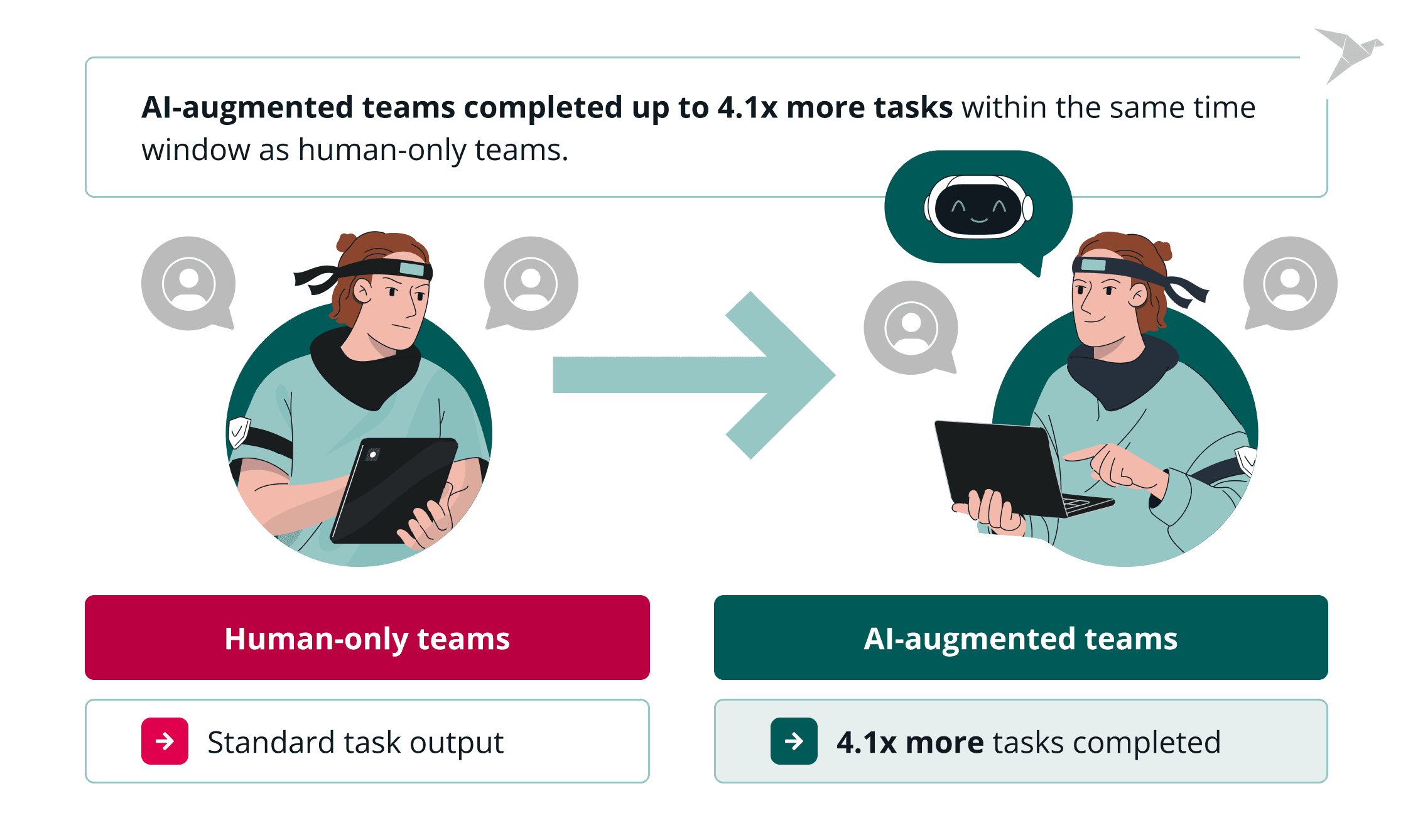
The Hack The Box benchmark report found that AI-augmented teams improved their challenge solve rate by 70% within the same time window compared to human-only teams. That speed advantage translates directly to finding vulnerabilities faster, which means less time for real attackers to exploit them first.
Learn how each type helps uncover vulnerabilities in different environments

How Do Human Pentesters Approach Security Testing?
Before comparing AI vs. humans penetration testing, it helps to understand what skilled human testers actually do and why their approach is difficult to replicate programmatically.
A human pentester thinks like an attacker. These ethical hackers use their expertise to conduct realistic, hands-on security assessments that go beyond automated tools. They build a mental model of the target, form hypotheses about where weaknesses might exist, test those hypotheses, and update their thinking based on what they find.
That loop – observe, reason, adapt – is what separates skilled testers from an automated scanner, allowing them to provide deeper insights and interpret behaviors that automated tools might miss.
Manual exploration of attack surfaces
Human testers don't follow a fixed checklist. They explore. When they encounter an application, they read it not just technically, but contextually. They notice unusual parameters, inconsistent behaviors, and features that don't quite fit the rest of the design. These observations often lead to the most interesting findings.
This kind of exploratory work relies on pattern recognition built from years of experience across different environments, industries, and attack types.
Chaining vulnerabilities into real attack scenarios
Individual vulnerabilities rarely tell the full story. A low-severity finding in isolation might become critical when combined with two others. Human testers are good at seeing those connections.
An example: a server-side request forgery (SSRF) flaw leads to access to cloud metadata, which exposes temporary credentials, which can be used for privilege escalation through a misconfigured identity policy. Each step looks minor on its own. Together, they represent a full compromise path.
Current AI agents see individual findings. Humans see chains. That difference has a direct impact on the quality and realism of a pen test report.
Business logic and workflow abuse testing
Some of the most damaging vulnerabilities are gaps in how a system is designed to work.
Coupon stacking, refund arbitrage, approval flow bypasses, account takeover through predictable user behavior. All these require understanding the intended business logic and modeling how it can be abused. An AI agent has no baseline understanding of how a business is supposed to operate. A human tester who has been briefed on the client's environment can reason about that gap directly.
This is one area where human judgment remains clearly ahead, and it's not a small category. Business logic vulnerabilities are consistently among the most impactful findings in real-world engagements.
Adapting to unexpected system behavior
Real environments don't behave the way documentation says they should. Systems are misconfigured, interconnected in undocumented ways, or running legacy components that behave unpredictably. Human testers encounter something unexpected and adjust, changing their approach, following a new thread, or recognizing when something unusual is worth investigating further.
They also know when to stop. Mid-test judgment calls (Is this target in scope? Is this a production system I shouldn't touch? Should I pause because something looks wrong?) require situational awareness that current AI agents don't reliably have.

I believe that there are many checks that can be safely handled by the agent autonomously, for example, static code analysis, testing for default credentials, missing basic security controls (headers, TLS misconfigurations), XSS, injections, IDORs, and some other checks.
But, there are categories of issues like Broken Access Control flaws or Race Conditions that can be dangerous in terms of the potential information disclosure or environment availability, especially if we’re talking about pentests in production environments or when the app is fragile, and you should be careful when doing security checks.
In case of access control testing, human intervention is also required in order to handle how the process will work, provide credentials/authentication details for testing, etc.
What Are the Key Differences Between AI Pentesting and Human Pentesting?
AI pentesting and human pentesting differ across five key dimensions: AI delivers superior speed, scale, and continuous coverage, while human testers provide the contextual understanding, creative exploitation, and validation judgment that automated tools still cannot replicate. The two approaches complementary rather than interchangeable.
In comparison AI pentest or humans pentest, it is essential to understand these core differences.
Speed and scalability vs. depth and creativity
AI agents work fast and don't stop. The Hack The Box benchmark found that AI-augmented teams completed up to 4.1x more tasks within the same time window as human-only teams.
But speed isn't the same as depth. Novel attack paths and creative exploitation chains still require human testers who can reason beyond pattern matching. The same benchmark showed the solve-rate advantage dropped from 3.2x overall to just 1.7x among the top 5%, so experienced testers already close most of the gap.
Automation vs. contextual understanding
Automated tools are consistent: they don't fatigue, don't skip steps, and scale across hundreds of endpoints in parallel. What they lack is context.
An AI agent doesn't know that a "low severity" finding is actually critical given a client's specific compliance posture. It doesn't know which endpoints handle sensitive transactions. Human testers carry that context natively, and it directly affects the quality of findings.
A 2025 MIT study found that 95% of corporate generative AI deployments failed to deliver returns due to unclear ownership and workflows that weren't redesigned around how AI actually behaves. Security is no different.
Detection vs. real exploitation validation
AI agents are increasingly capable of detection. They flag misconfigurations, identifying known patterns, correlating findings. But validating whether a finding is real, exploitable, and relevant still requires human judgment.
According to Ponemon Institute research, 40% of investigated security alerts turn out to be false positives, and organizations receive an average of nearly 17,000 alerts per week, of which only 19% are even deemed reliable enough to act on. Dropping AI-generated findings into a client report without human validation is a trust-destroying event.
Roughly 98% of AI-assisted pen testing across the industry remains heavily human in the loop, even among teams with strong engineering behind their setups.
Cost efficiency vs. quality of insights
Heavy AI API usage runs around $72,000 per year per instance. It is significant, but lower than the fully loaded cost of broad manual coverage. According to Glassdoor, the average salary for an information security analyst in the US reached $136,842 in early 2026, and experienced penetration testers with specialist skills command considerably more.
The economics favor AI for coverage work. They favor humans for depth: chained vulnerabilities, business logic flaws, and novel findings that carry disproportionate value in a real engagement.
Where each approach leads in practice
- AI handles coverage, speed, and known-pattern detection.
- Humans handle depth, judgment, and context.
The strongest programs in an AI pentest vs. humans pentest comparison combine both deliberately.
What are the tasks you'd trust an AI agent to handle independently, and what would you never hand off without human oversight?
More than the specific tasks, I believe it depends on the environment being tested. It’s not the same to run a test in a pre-production environment that’s a copy of production, where breaking something doesn’t have major consequences, and there’s no real user data, as it is to test a live environment. In the first case, I’d trust agents more, even if I’d still double-check their work later.
In live environments, I need to be sure that whatever is executed stays within clear guardrails so there’s no impact on the company. There are good examples of why this matters, like the research Richard Fan did on the AWS Security Agent, where some agents executed unnecessarily dangerous actions, such as using DROP TABLE as an initial probe. That’s something you don’t want to see against a production environment (even in preprod is scary).
In web penetration testing, client-side tests or those that don’t affect the backend are generally safer to handle independently. But once you start touching the backend, especially anything that can modify data or affect availability, I’d be much more restrictive about what I allow an agent to do.
And of course, one task they handle really well, and that not many pentesters enjoy but is one of the most important, is reporting. With the right context and outputs from tools, agents can build reports that genuinely add value.
How Should Companies Combine AI and Human Pentesting Effectively?
There's no shortage of opinions on AI penetration testing agents vs humans, but the most effective security teams build a strategy that uses both, each where it performs best. Here's how to do that in practice.
Continuous AI-driven testing as a baseline
AI-powered tools run continuously, catching the predictable stuff like misconfigurations, known vulnerabilities, and exposed endpoints. Threats don't follow a quarterly schedule, and neither does your codebase. Things change fast.
AI handles that volume well. It's not a replacement for deeper testing, but it's a reliable baseline that keeps your attack surface visible at all times.
Periodic human-led penetration testing
Yes, AI continuous testing catches a lot. But it doesn't catch everything, especially when it comes to the complex, chained vulnerabilities that require creative thinking, contextual judgment, and real-world attacker logic.
Schedule human-led engagements and pentesting services at regular intervals (at a minimum annually, but ideally aligned with major releases, infrastructure changes, or new compliance requirements). These engagements go deeper, and a skilled tester can follow an unexpected thread, adapt mid-test, and simulate the kind of lateral thinking an actual attacker uses.
A well-functioning hybrid team is a team of experienced pentesters who know how to find and exploit different security vulnerabilities, and with the help of AI tools/agents, they are able to cover a lot more in the same amount of time.
Using AI to support – NOT replace – experts
The better model is human-led, AI-assisted. Pentesters act as orchestrators: they define the scope, validate that testing is covering what it should, and verify that AI agents are doing what's expected. AI handles the execution of specific tasks, especially the repetitive or time-consuming ones.
One practical example is on-the-fly script building. In the past, writing a custom script for a specific testing scenario could take hours or simply wasn't feasible under time constraints. With AI assistance, testers can generate tailored scripts quickly, which makes them faster and enables tests that wouldn't have been practical before.
There's also a collaborative dimension. Using AI as a brainstorming partner, where human intuition meets AI pattern recognition, often surfaces test cases neither side would reach alone. That back-and-forth is where the real value lives.
What I believe works well right now is not letting an AI agent run the entire penetration test and then reviewing the results afterward. Instead, the pentesters should act as orchestrators, ensuring the test follows a proper process, that everything within scope is actually tested, and that the agents performing tasks are doing what's expected.
AI also extends what teams can cover in a given engagement. When facing unfamiliar technologies, AI can accelerate the research phase instead of stalling the test. And for secure code reviews, large codebases that would take days to analyze manually can be mapped much faster — with AI tracing data flows across functions and endpoints in a fraction of the time.
Larger codebases take a lot of time for the investigation and understanding of how the processes work, whereas AI instruments can help to better cover and visualize data flows across certain functions and endpoints in a short amount of time. Practical experiments show that this is still more cost-efficient than conducting a review manually.
Aligning testing strategy with risk and compliance
Not every system carries the same risk. A public-facing payment API needs more scrutiny than an internal dashboard with limited access. Your testing strategy should reflect that.
Start by mapping your assets and ranking them by risk. Then assign testing methods accordingly:
- High-risk systems: continuous AI monitoring plus frequent human-led testing.
- Medium-risk systems: continuous AI coverage with periodic human review.
- Lower-risk systems: AI-driven scanning with human oversight on findings.
Compliance requirements, such as SOC 2, ISO 27001, PCI DSS, or HIPAA, often mandate specific testing frequencies and documentation standards. AI tools can help you maintain audit trails and generate consistent reporting. Human testers, on the other hand, bring the nuanced judgment that compliance frameworks increasingly expect, especially when assessors want evidence of real threat simulation.
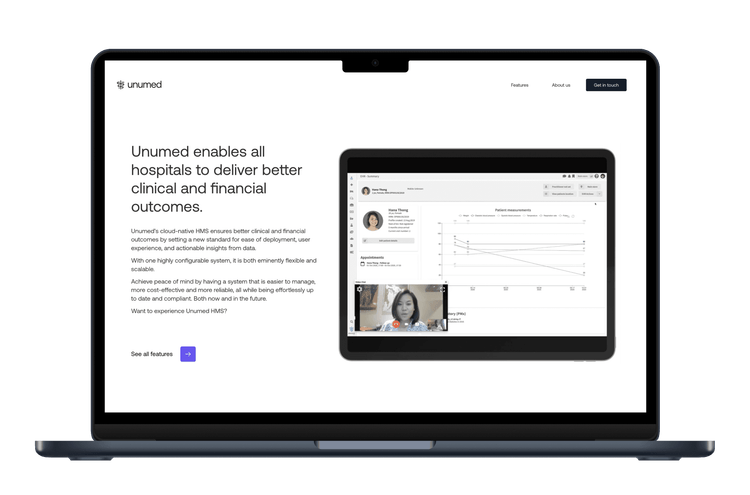
Penetration testing of a cloud-native hospital management system before the annual ISO 27001 audit
The Future of Pentesting Is Hybrid, And the Bar Is Rising
AI pentesting services are changing how security experts scope, execute, and report tests, and that's largely a good thing. Incorporating agents into regular security workflows is a natural evolution, just as automated scanning tools were before them.
But at TechMagic, we've seen what gets missed when automation runs without experienced human oversight. Business logic vulnerabilities, context-specific threats, and risks that only make sense when you understand how a client actually operates.
That's why we always start by thoroughly understanding your environment before recommending anything. The right combination of AI tooling and human expertise looks different for every client, and we build it that way.
A word of caution if you're evaluating vendors
"Agentic pen testing" is becoming a marketing term. Before you buy, ask what's actually behind it.
Many of these offerings are quite a black box, where you don't really know what's being tested or how it's being done. That lack of transparency is something to be careful with. You should be able to understand how their agents work at a high level, what kind of testing they perform, and what level of control and visibility you or they will have. If they can't clearly explain that, it's probably not a good idea to move forward.
Under the hood, many agentic solutions are still running familiar tools like proxies or scanners like Nuclei or Nikto with an LLM layered on top to interpret results and generate reports. That's useful, especially for teams without dedicated security staff. But it has limits.
Experienced pentesters can find more non-trivial vulnerabilities, especially with the help of AI. Agentic pentesters reduce false positives, but from my own experience, there is still room for improvement.
The due diligence you'd apply to any traditional pentesting vendor applies here, too. Check certifications, methodology, and scope clarity. With agentic offerings, go a step further. If a vendor can't explain how their agents work, what they test, and who's accountable for the results, that's your answer.
Final Thoughts
AI agents bring speed, scale, and consistency. They run continuously, catch known vulnerabilities, complete repetitive tasks, and handle the volume of modern attack surfaces that human teams simply can't match alone. But they don't reason about business logic, they don't chain findings the way experienced testers do, and they still produce false positives that require human judgment to filter.
Human experts bring depth, creativity, and context. They explore, adapt, and understand how a business actually works and can model how it can be abused. That judgment remains difficult to replicate programmatically across all types of penetration tests.
The strongest security programs build a layered approach: AI as a continuous baseline, human supervision leading the engagements that require real thinking, and both working together in the same workflow.
If your team is just starting to explore AI-assisted testing, the experts we spoke to have clear advice.
You really want to understand what's happening as much as possible. If in the past you didn't want to execute an exploit without understanding what it was doing, now you shouldn't execute AI automated tasks without understanding what they do. It's not about knowing every single test that's attempted, but rather about understanding the potential impact, monitoring execution traces, and having enough visibility into what's happening.
If your team already has a solid process for a specific task, don't hand it to an agent for the sake of it. Use AI to speed up deterministic scripts, then apply models where they actually add value: reasoning, summarization, tasks that are hard to encode in code. Replacing what already works introduces unnecessary error without meaningful gain.
Start by defining your objectives and where you would like to be in 6–12 months. Develop your own set of benchmarks and test applications to evaluate the effectiveness of different AI tools. The market rapidly changes, so be ready to try out new solutions and constantly look for new opportunities.
The framing “clear goals, honest benchmarks, staying flexible” is a better foundation than chasing whatever agentic tool launched last week. The technology is moving fast, but the fundamentals aren't. Understand your environment, know your risk, and build a testing program that reflects both. AI excels at making that program faster and broader, and human creativity and expertise make it credible.

FAQ

No. AI or humans pentest is a false choice. The most effective security testing combines both. AI handles repetitive reconnaissance and scanning at scale, but senior human testers are irreplaceable when it comes to complex logic flaws, creative exploitation, and compliance-driven assessments. Human ingenuity is highly important.
Partially. AI-driven testing is highly reliable for report writing, known vulnerability patterns, and broad attack surface coverage. However, it lacks the contextual judgment of manual penetration testing needed for nuanced findings like misconfigurations, chained vulnerabilities, and business logic flaws, which still require human validation to be actionable.
Artificial Intelligence struggles with anything that requires reasoning beyond its training data: novel attack vectors, ambiguous security controls, and client-specific risk context. It also can't take accountability for findings the way a certified human auditor can, which matters greatly in regulated industries. So, human involvement is essential.
AI pentest vs humans is about the role. AI-driven tools dramatically accelerate offensive security coverage and consistency across web, API, and cloud environments. It excels in identifying patterns. Human-led testing brings creativity, certification-backed authority, and the critical thinking needed when the stakes are highest in the discovery of critical vulnerabilities.
Human expertise remains essential for validating findings and identifying misconfigurations in dynamic environments, and a hybrid approach defines what modern penetration testing looks like and provides comprehensive coverage.